
The Guest, an AI agent designed to moderate meetings and promote participation in extended reality environments, showcased in Brussels
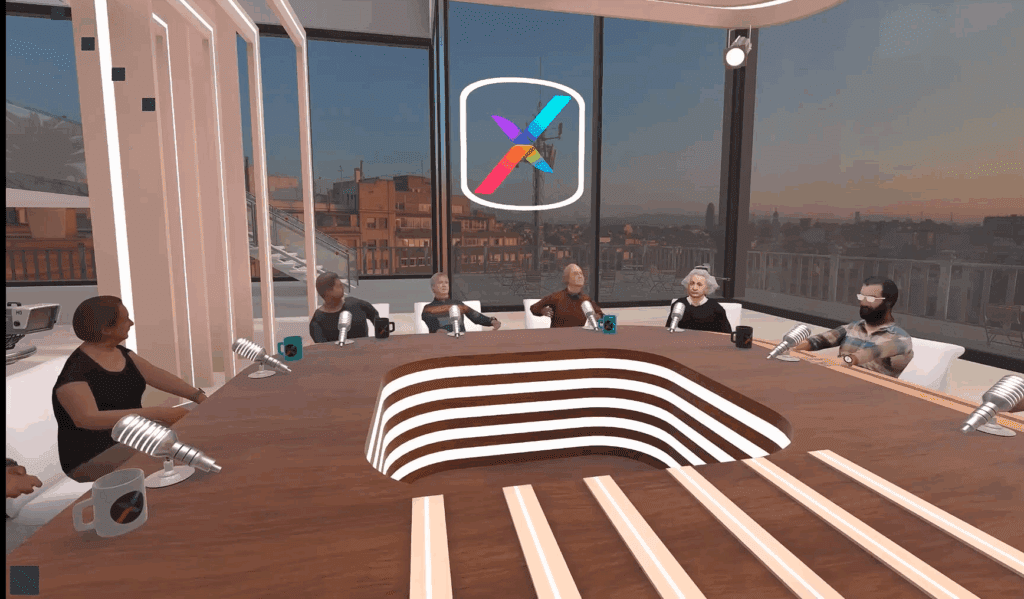
- The European GuestXR project, coordinated by Eurecat, has created an artificial intelligence agent that integrates into extended reality environments to help meeting participants communicate better, mitigating conflict and equalizing speaking time between participants constructively.
- The final event, held in Brussels on November 28th, showcased the project’s results in a round table session, held in a virtual environment and moderated by The Guest itself, with contributions from experts representing the organizations that participate in GuestXR.
- The GuestXR has been tested in four use cases that focus on participants awareness on climate change, conflict resolution, social applications for hearing impaired participants and the recreation of historical protests to study group dynamics.
The European GuestXR project has presented an innovative artificial intelligence agent named The Guest, which integrates into extended reality environments to moderate meetings and promote participation. This agent is capable of observing behaviour and detecting exclusion among the participants, and in this way, it intervenes to facilitate interaction, reduce conflict, and foster empathy, thus helping the group achieve their meeting’s objectives.
During the final event, held in Brussels on November 28th, the project’s results were presented through a roundtable session conducted in a virtual environment and moderated by The Guest itself, with the participation of experts from the entities that are part of GuestXR consortium, coordinated by the Eurecat technology center.
Welcome everyone to our XR round table. I am The Guest, an AI agent designed to help groups have constructive, inclusive discussions in virtual spaces. Today we will talk about challenges, lessons learned, and future directions of the GuestXR project”
The Guest, the AI agent developed, during its introduction to the round table.
Its main goals were to equalise participation, maintain a constructive, calm, and curious tone, focus the discussion on the project’s results, and, if conflict arose, de-escalate and refocus on understanding and shared goals, all while keeping within the allotted time.
This presentation has been an example of how The Guest could be applied in real life. Whether for working groups or debates, every gathering of people held in extended and augmented reality has a purpose, and the agent’s goal is to help the group achieve that. This project has involved exciting research with a strong interdisciplinary component, breaking new ground and hopefully contributing to the success of social Virtual and Augmented Reality
Mel Slater, project's scientific coordinator from the University of Barcelona
The GuestXR machine-learning system has been developed to trial social situations that may trigger conflict or debate, employing virtual reality and artificial intelligence to build a metaverse for good. The project has developed two applications that allow the participants to, on one hand, explore different perspectives in conflict situations by being put on the shoes of the other, and, on the other hand, examine the dynamics of social protests, exploring factors that can turn these gatherings violent.
Moreover, GuestXR has created an innovative extended reality game that immerses participants in scenarios where players confront the consequences of resource mismanagement to raise environmental awareness, as part of a research study of individual and group dynamics towards resource scarcity.
The project solution has also been evaluated during interactions involving participants with some degree of hearing impairment, incorporating new tools and methodologies to optimize acoustics in extended reality to help people with hearing difficulties joining in the meetings and enhance speech understanding, with the aim of promoting their social inclusion in virtual and augmented reality environments.
Additionally, The Guest was tested in simulations of historical protests to investigate how and when the users were engaged by the AI-agent into the protests and the elements that turned them violent. This specific use case was selected as part of an Open Call to make the project’s extended reality technologies accessible to fellow academics and professionals.
The awarded team, a group of researchers from the Norwegian University of Science and Technology (NTNU) and the UiT The Arctic University of Norway, have used The Guest to investigate individual and group responses during protests, and analyse the events from different perspectives, touching upon pedagogical and artistic perspectives, through the virtual recreation of demonstrations for the women’s abortion rights in Warsaw, the pro-democracy “Be Water” protests in Hong Kong, and climate demonstrations.
The GuestXR consortium, funded by Horizon 2020, is made up of the Eurecat technology center, the Event Lab at the University of Barcelona, the Inria Center at the Rennes University, the Advanced Reality Lab and The Baruch Ivcher Institute for Brain, Cognition and Technology at Reichman University, the Brain and Emotion Lab and the Brightlands Institute for Smart Society (BISS) at University of Maastricht, the University of Warsaw and the companies Virtual Bodyworks and g.tec medical engineering GMBH.